Introduction: The Crucible of Eccentricity
To the outside observer, Great Britain is often associated with stiff upper lips, orderly queues, and quiet tea drinking. This is a carefully manufactured public relations campaign. Scratch the sterile surface of modern compliance, and you will find a nation deeply committed to the chaotic, the dangerous, and the completely absurd.
For centuries, local communities across the British Isles have resisted administrative sanitisation by clinging to rituals that make modern risk assessors weep. These are not mere amusements; they are tests of endurance, community solidarity, and defiance. Here are the ten most eccentric British traditions, presented with their historical truth and raw civic grit.
1. Shrovetide Mob Football (Atherstone)
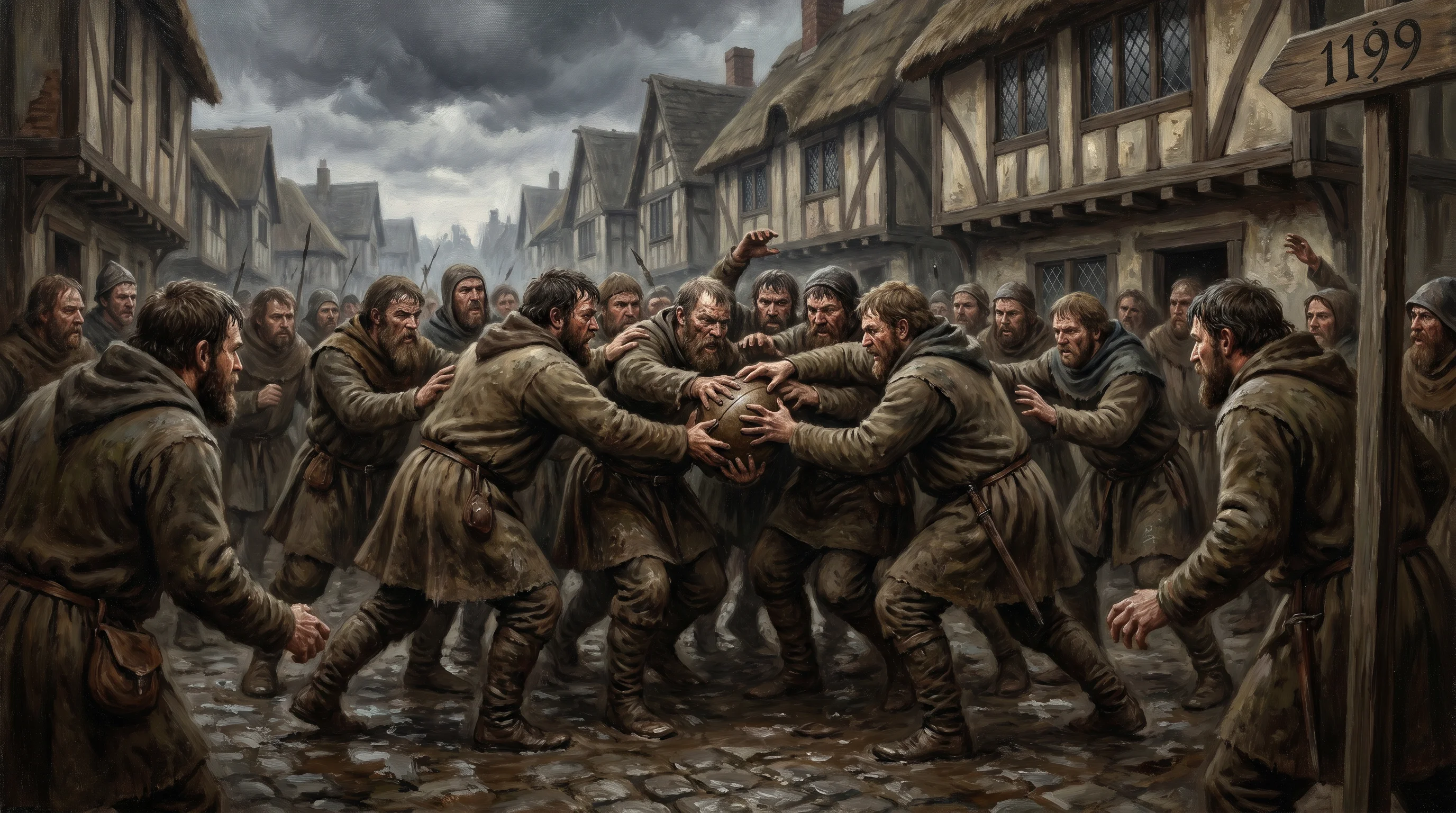
Long before football was codified into a highly lucrative entertainment industry for the faint-hearted, it was a town-wide medieval brawl. Traced back to 1199 during the reign of King John, the Atherstone Ball Game is played annually on Shrove Tuesday.
The playing field is not a manicured pitch, but Watling Street (now Long Street). The rules are minimal: participants are forbidden from killing anyone, and play is restricted to Long Street. The prize? The water-weighted leather ball itself, which must be held when the final whistle blows after two hours of pure, possession-based warfare.
The Atherstone Ball Game
Watling Street, Warwickshire
Key Takeaways
- 1 Traced back to 1199 during the reign of King John.
- 2 The match lasts two hours with minimal rules: no killing, stay on Long Street.
- 3 The winner is the one holding the ball when the final whistle blows.
“It wasn’t a game; it was a civic crucible of survival and endurance.”
2. Royal Shrovetide Football (Ashbourne)
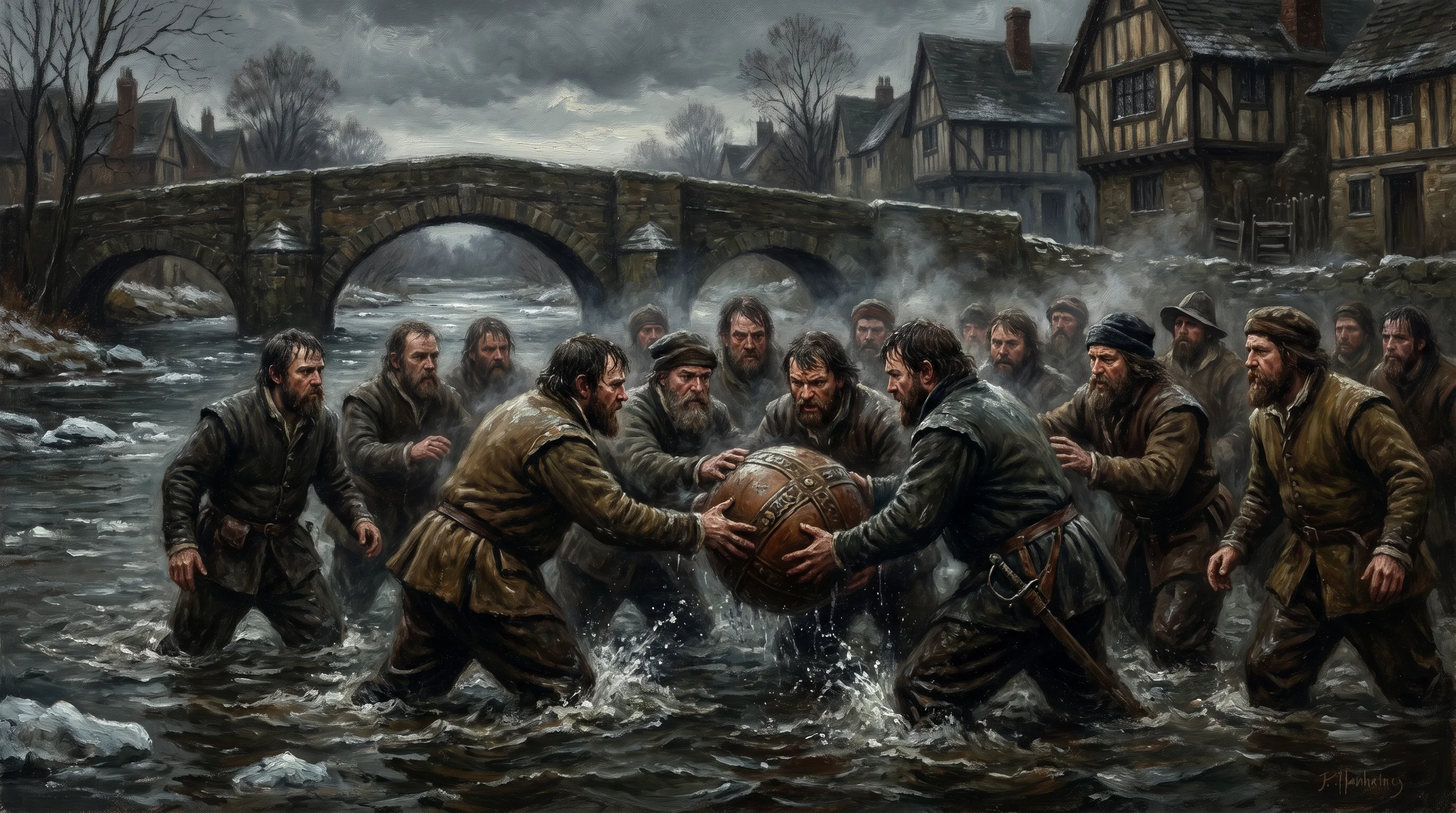
In Ashbourne, Derbyshire, the Shrovetide match splits the entire town into two teams: the “Up’ards” (born north of the Henmore Brook) and the “Down’ards” (born south). The goals are stone river plinths located three miles apart, and the match lasts sixteen hours across two days.
This is a town-wide aquatic siege. In 1928, Edward VIII (then Prince of Wales) turned up the ball, took a bloody nose for his troubles, and called it royal patronage. It remains a grueling trial of physical pressure, where scoring a goal requires standing in freezing currents to tap the leather ball three times against a stone plinth.
Royal Shrovetide Football
Ashbourne, Derbyshire
Key Takeaways
- 1 The match splits the town into Up'ards and Down'ards.
- 2 Goals are old stone mill wheels located three miles apart.
- 3 Scoring requires standing in freezing currents to tap the ball three times.
3. Cooper’s Hill Cheese-Rolling
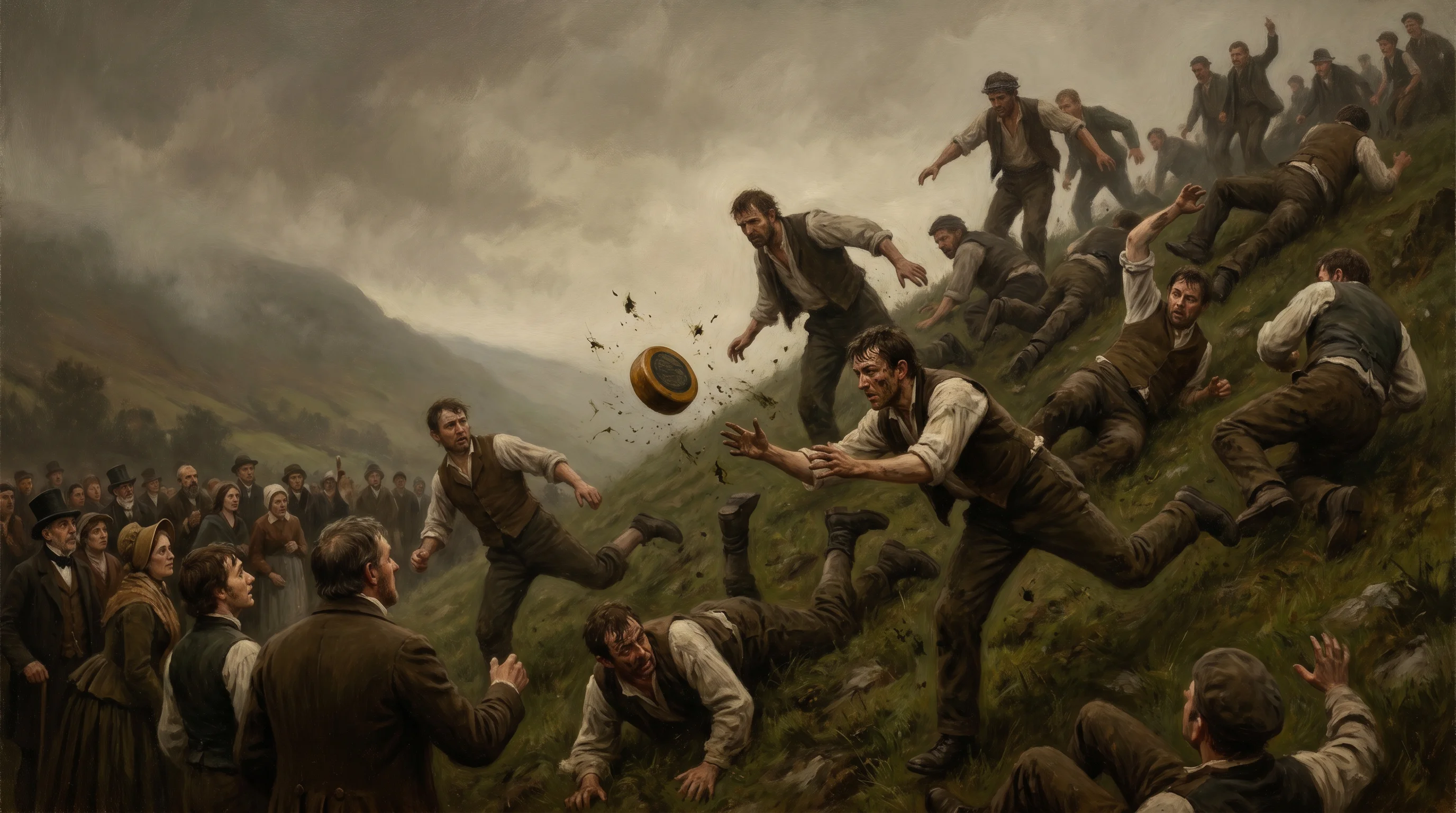
Every May, agricultural labourers and reckless tourists gather at Cooper’s Hill in Gloucestershire to pursue a seven-to-eight-pound wheel of Double Gloucester cheese down a near-vertical 50-percent gradient cliff. The cheese can reach speeds of seventy miles per hour, frequently outrunning the competitors who tumble head-over-heels in pursuit.
Bureaucrats and police have repeatedly tried to cancel the event due to the inevitable triage of broken bones at the bottom. They have failed. In 2013, they tried to replace the cheese with a foam replica to curb liability; the crowd ignored the threat, and the unofficial event continued. In Gloucester, Delaney Irving famously won the ladies’ race in 2023 while completely unconscious.
Cooper's Hill Cheese-Rolling
Brockworth, Gloucestershire
Key Takeaways
- 1 Competitors chase an eight-pound wheel of Double Gloucester cheese.
- 2 The hill is a near-vertical 50-percent gradient cliff.
- 3 The cheese can reach speeds of seventy miles per hour.
4. The World Worm Charming Championships
In Willaston, Cheshire, the ancient assembly place mentioned in the Domesday Book of 1086 hosts a far more rigorous modern competition: worm charming. Meticulously split into a three-by-three-metre grid, competitors have thirty minutes to charm as many earthworms as possible out of the soil without digging or watering.
Charming is achieved through acoustic manipulation and vibration—typically by sticking a garden fork (a “stob”) into the ground and vibrating it with a wooden board (“rooping iron”). In 1980, local lad Tom Shufflebotham established a global benchmark by charming 511 worms in thirty minutes. The event is strictly governed by eighteen rules to protect the annelids.
5. The Tar Barrels of Ottery St Mary
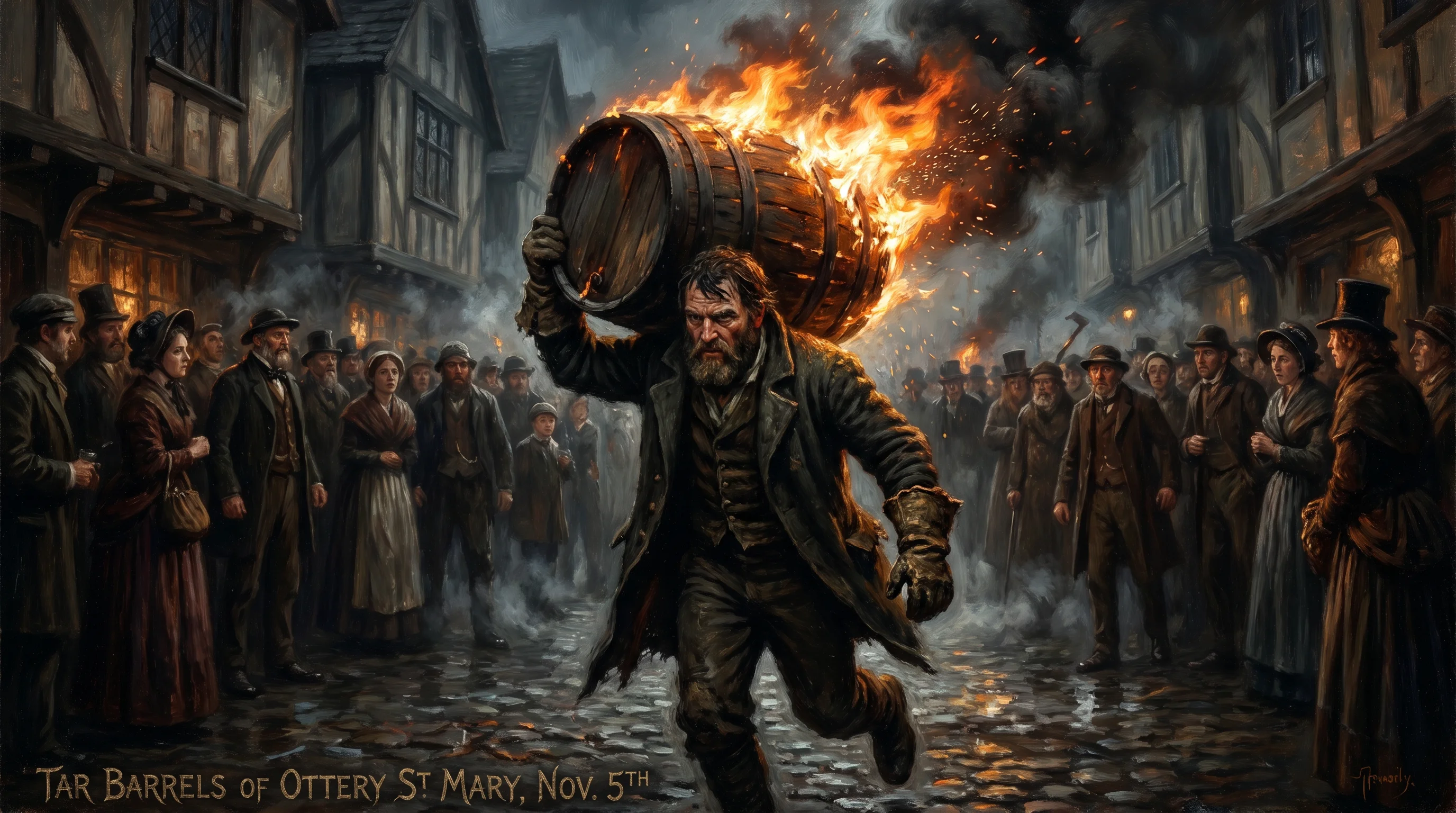
On the night of November 5th, while the rest of the UK lights modest bonfires to mark the collapse of the Gunpowder Plot, the residents of Ottery St Mary in Devon carry blazing, thirty-kilogram barrels of tar on their shoulders.
Ottregians carry these burning hogsheads through packed town streets, wearing homemade wire-and-hessian gloves to protect against dripping, boiling tar. Participation is an exclusive birthright passed down through families. Even children as young as seven are trained on smaller barrels, keeping the fiery custom alive despite astronomical insurance costs.
The Tar Barrels of Ottery St Mary
Ottery St Mary, Devon
Key Takeaways
- 1 Ottregians carry burning, thirty-kilogram barrels of tar through town.
- 2 Participation is an exclusive birthright passed down through families.
- 3 Homemade wire-and-hessian gloves are used to handle the boiling tar.
6. The Haxey Hood
Dating back to 1359, the Haxey Hood is North Lincolnshire’s oldest surviving winter ritual. It began when Lady de Mowbray lost her silk hood to a gust of wind, and thirteen farmhands gave chase. Amused by the chaos, she granted thirteen acres of land on the condition that the chase be re-enacted every January 6th.
The game centres around the “Sway”—a massive human wall of hundreds of men pushing a two-foot corded leather tube (the Hood) through freezing mud toward one of four participating village pubs. The Lord of the Hood, the Fool (who is ceremonially smoked over a straw fire), and eleven Boggins in red hunting coats supervise the struggle.
7. The Whittlesey Straw Bear
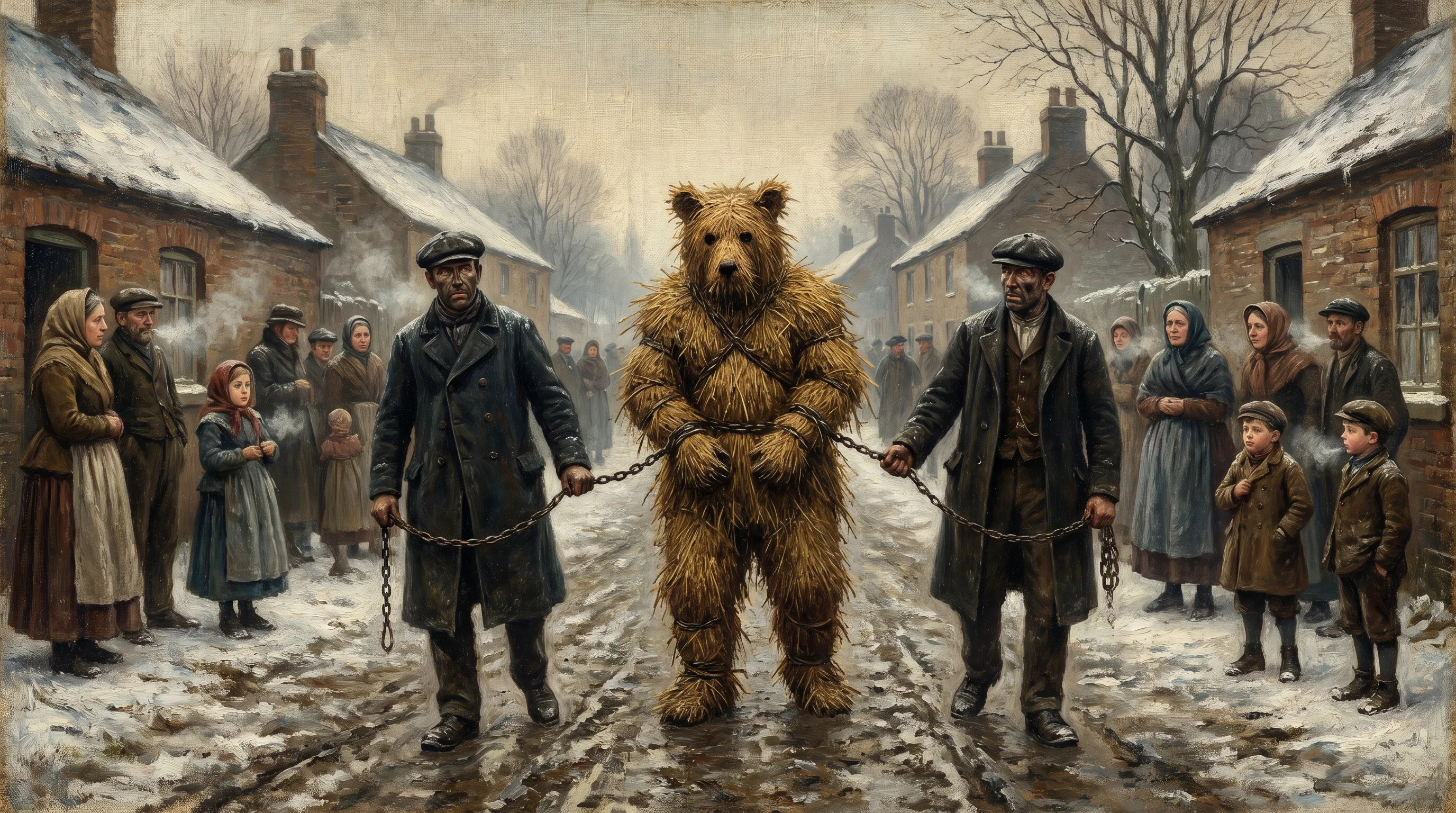
On Plough Tuesday in the Fenland town of Whittlesey, Cambridgeshire, a local man was historically wrapped door-to-door in seventy pounds of harvest straw. This “Straw Bear” was led on a chain by ploughboys with blackened faces, performing dances in exchange for beer and food to survive the unworkable winter frost.
The custom was banned by police in 1909 under the Vagrancy Act for “cadging” (begging). In 1980, the Whittlesey Society successfully revived the custom. The modern festival culminates in the ceremonial burning of the straw bear suit, a cathartic release to fertilise the soil for spring.
The Whittlesey Straw Bear
Whittlesey, Cambridgeshire
Key Takeaways
- 1 A local man is wrapped in seventy pounds of tightly bound harvest straw.
- 2 Ploughboys led the bear door-to-door in exchange for food and beer.
- 3 The festival culminates in the ceremonial burning of the straw bear suit.
8. World Gurning Championship (Egremont)
The Egremont Crab Fair in Cumbria dates back to 1267, when King Henry III granted a royal charter to Thomas de Multon. The fair began with the Lord distributing sour crab apples to serfs. From that bitterness grew the art of “gurning”—contorting one’s facial expression into the most grotesque form possible.
Competitors frame their faces through a traditional leather horse collar (a “braffin”). To gurn is to discard all conventional standards of beauty, crowning the most hideous face supreme. Cumbrian legend Tommy Mattinson, a multi-time champion, famously wore his braffin to meet Queen Elizabeth II.
9. The Dunmow Flitch Trials
First recorded in 1104 at the Augustinian Priory of Little Dunmow, Essex, the Flitch Trials award a “flitch” (a cured side) of bacon to any married couple who can kneel on sharp stones before a mock court and swear under oath that they have not regretted their marriage for a year and a day.
Claimants are subjected to aggressive cross-examination by wigged barristers, and a jury of six maidens and six bachelors decides their fate. It is a grand piece of public theatre, proving that marital success has been subjected to fierce public scrutiny for preserved pork since the Middle Ages.
10. British Bulldog
Codified in the 1930s by the Boy Scout movement, British Bulldog was the ultimate playground rite of passage. The rules are simple: players sprint from one side of a concrete playground to the other while a “bulldog” in the centre attempts to tackle them. Those caught join the centre, creating an escalating gauntlet of physical collision.
During the Second World War, the game was framed as a test of imperial pluck and grit. By the 1980s, due to concussions and broken bones, the British Medical Journal warned of its dangers, leading to widespread playground bans. Despite institutional suppressions, it remains a legendary piece of childhood folklore.
Conclusion: Outlasting the Censors
These ten traditions represent a defiance of the sterile, safety-inspected modern world. They are living links to a time when community was forged in shared risk, agrarian hardship, and tongue-in-cheek comedy. While committees and regulators try to standardise the public sphere, the British urge to dive into freezing rivers, run with fire, and chase dairy down vertical cliffs remains completely unbroken.