Introduction: The Civilizational Clash
This series retells Joseph François Michaud’s 1812–1822 History of the Crusades*, including his own framing of the Crusades as a defensive civilizational response. That framing is Michaud’s argument, not a neutral modern consensus — historians remain divided on the balance of religious, defensive, and expansionist motives behind the Crusades.*
For nearly four centuries, the Christian world had endured a relentless tide of expansion. Since the rise of Islam in the seventh century, the historic lands of the Levant, North Africa, Egypt, and Spain had been conquered. Pilgrims journeying to the Holy Sepulchre in Jerusalem faced systematic persecution, arbitrary taxation, and violence. By the late eleventh century, the Seljuk Turks had swept through Anatolia, threatening the gates of Constantinople itself.
As Joseph François Michaud argued in his monumental History of the Crusades, they were not an unprovoked campaign of colonial conquest but a delayed, defensive response by Western Christendom to preserve its civilization, secure the borders of Europe, and liberate the holy sites of their faith.
1. The Call at Clermont (1095)
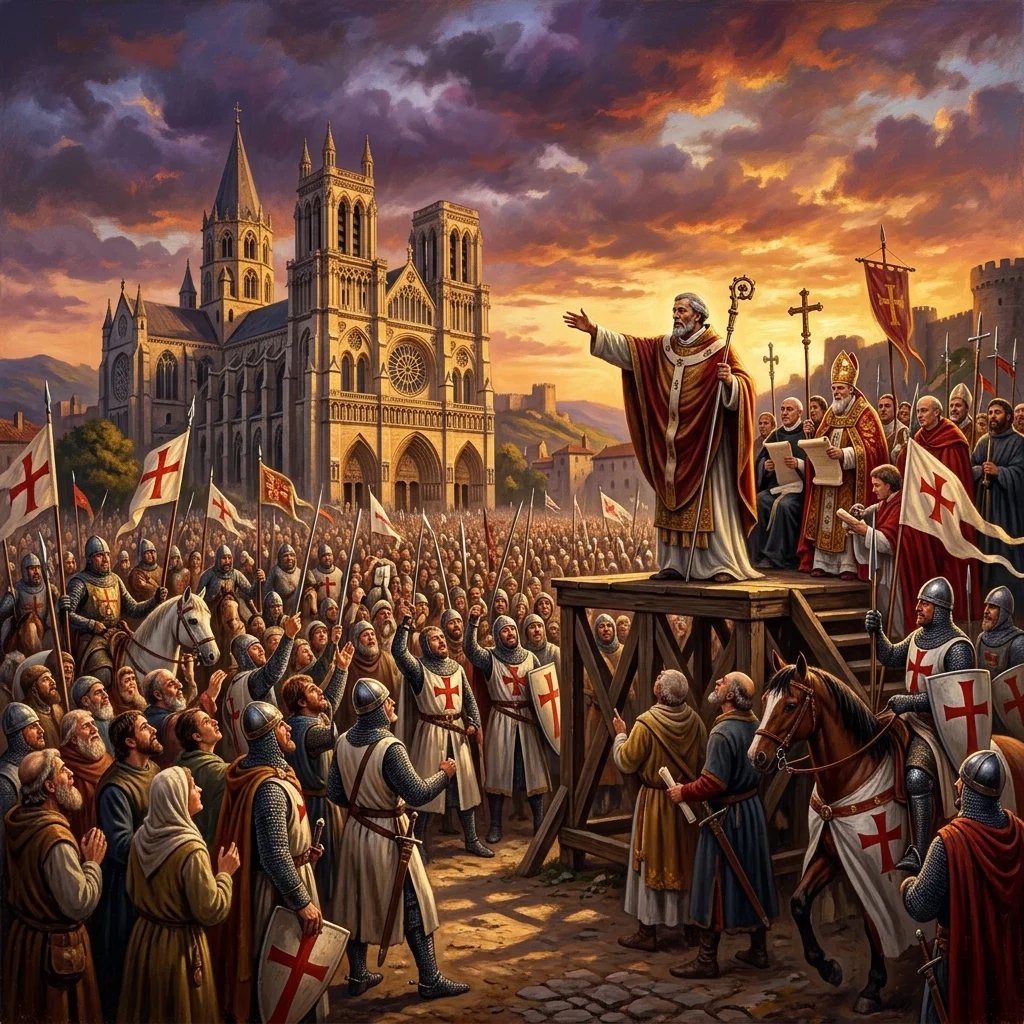
In November 1095, Pope Urban II convoked the Council of Clermont in France. Before a vast assembly of clergy, nobles, and commoners, he laid bare the plight of Eastern Christians and the desecration of the Holy Places.
Pope Urban II Preaching the First Crusade
The Council of Clermont (1095)
Key Takeaways
- 1 Defensive response to Byzantine appeals for aid.
- 2 Re-securing pilgrim routes to the Holy Sepulchre.
- 3 The unifying cry of Western Europe: 'Deus vult!' (God wills it!)
Urban’s words ignited a fire that had been smoldering for generations. The crowd erupted into a single, thunderous cry: “Deus vult! Deus vult!” Nobles and peasants alike cut strips of red cloth to form crosses, pinning them to their shoulders as a sacred vow. The march to redeem the East had begun.
2. The People’s Crusade: Zeal without Knowledge (1096)
Before the great lords could organize their armies, a massive, uncoordinated vanguard set out under the preaching of Peter the Hermit and the knight Walter the Pennyless. Lacking military discipline, supplies, or strategic foresight, this “People’s Crusade” marched through eastern Europe.
Though fueled by genuine religious devotion, their lack of order led to tragic clashes with the local populations of Hungary and the Balkans. Upon crossing the Bosporus into Anatolia, they were easily ambushed and annihilated by the Seljuk forces at the Battle of Civetot. It was a somber lesson: zeal alone, without the discipline of chivalry, would not suffice.
3. The Princes Assemble: The Chivalry of Europe
In the autumn of 1096, the professional military elite of Western Europe set forth. Unlike the first wave, these were seasoned warriors led by the finest captains of the age:
- Godfrey of Bouillon: Duke of Lower Lorraine, a man of legendary piety, physical strength, and humility.
- Bohemond of Taranto: A brilliant Norman strategist, towering in stature and skilled in eastern warfare.
- Raymond IV of Toulouse: The wealthy, veteran count who took the vow to die in the Holy Land.
- Tancred of Hauteville: Bohemond’s cousin, the very model of youthful chivalry and daring.
These forces converged on Constantinople, where they forged a uneasy alliance with the Byzantine Emperor Alexios I Komnenos, promising to return recovered imperial lands in exchange for supplies and passage.
4. First Clashes: Nicaea and Dorylaeum (1097)
The Crusader host crossed into Asia Minor in May 1097. Their first objective was Nicaea, the Seljuk capital. After a close-fought siege, the city surrendered to Byzantine forces just as the Crusaders prepared to storm it.
Shortly after, marching in divided columns, the column led by Bohemond was ambushed near Dorylaeum by Sultan Kilij Arslan’s light horse archers.
The Battle of Dorylaeum (July 1, 1097)
Comparing the tactical forces of the clash in Asia Minor
For hours, the Norman knights held their ground under a hail of arrows. “Stand fast together, trusting in Christ,” Bohemond commanded. Just as the lines began to buckle, the heavy cavalry of Godfrey of Bouillon and Raymond of Toulouse arrived on the flank. The combined charge shattered the Seljuk army, opening the road through Anatolia.
5. The Ordeal at Antioch (1097–1098)
The march across the arid plains of Asia Minor took a terrible toll in heat, hunger, and disease. By October 1097, the Crusaders reached Antioch, a city defended by massive walls. The siege of Antioch dragged on through a bitter winter, decimating the Christian ranks.
In June 1098, through Bohemond’s secret negotiations with a Turkish guard inside, the Crusaders breached the walls and captured the city. However, their triumph was short-lived. The next day, a massive relief army under Kerbogha of Mosul arrived, trapping the exhausted Christians inside the very city they had just taken.
Starving and outnumbered, the Crusaders’ morale was restored by the discovery of what was believed to be the Holy Lance beneath the cathedral floor. On June 28, 1098, marching out of the gates in disciplined ranks, the Crusaders launched a desperate, all-out charge. Inspired by faith, they routed Kerbogha’s superior forces in a victory that contemporary chroniclers described as miraculous.
6. Jerusalem Delivered (1099)
In June 1099, the remaining Crusader force—now reduced to a fraction of its original size—finally stood before the walls of Jerusalem. The siege was conducted in scorching heat, with water scarce and defenders mocking the Christians from the ramparts.
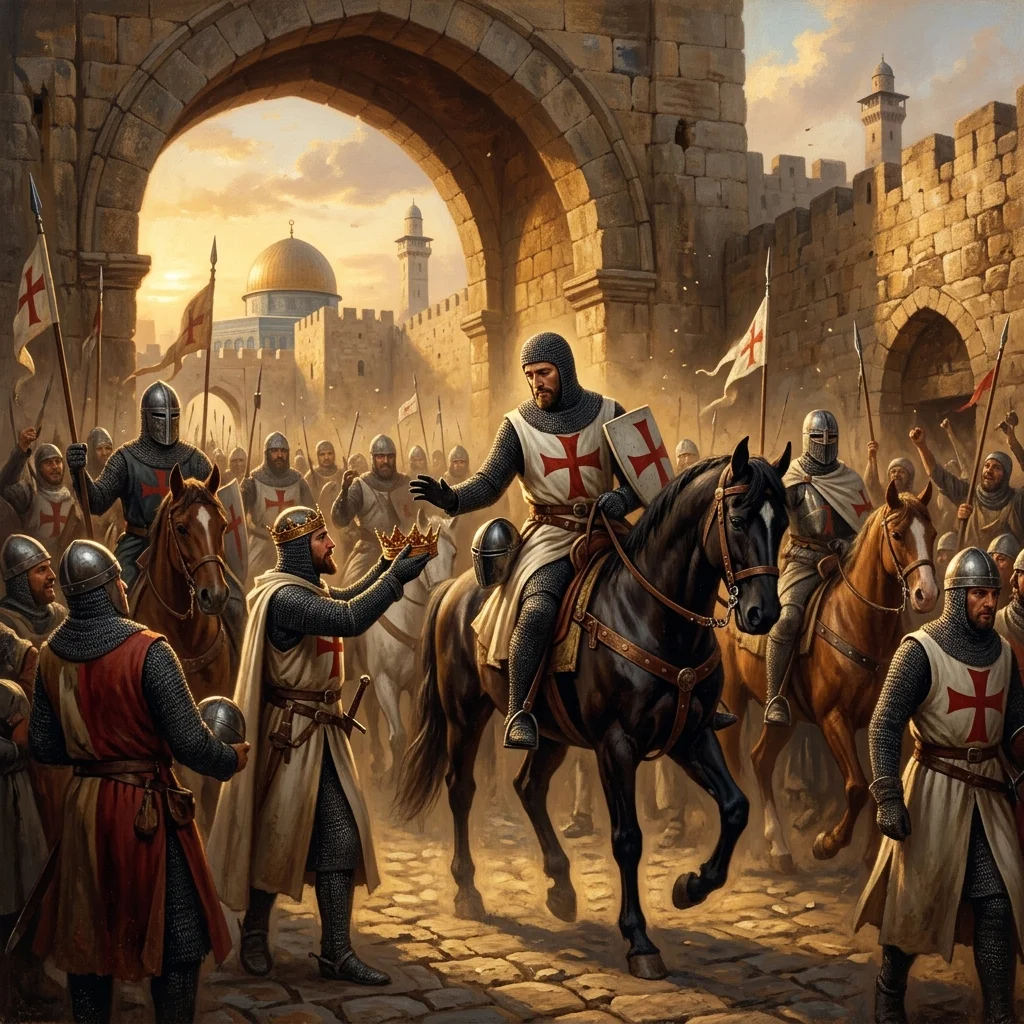
Godfrey of Bouillon Entering Jerusalem
The Delivery of the Holy City (July 15, 1099)
Key Takeaways
- 1 Siege towers constructed under heavy fire from local timber.
- 2 Breaching the northern wall on July 15, 1099.
- 3 Godfrey declines the crown: 'I will not wear a crown of gold where my Savior wore a crown of thorns.'
Using wooden siege towers built from timber brought from the coast, the Crusaders launched their final assault. On July 15, 1099, Godfrey’s tower reached the northern wall, and the Christian forces poured into the city.
After a brutal fight to secure the city, the Crusaders gathered in the Church of the Holy Sepulchre. In a powerful display of humility, Godfrey of Bouillon refused the title of King of Jerusalem, choosing instead the title Advocatus Sancti Sepulchri (Defender of the Holy Sepulchre), stating he would never wear a crown of gold in the city where his Lord had worn a crown of thorns.
Conclusion: The Legacy of Volume 1
The First Crusade succeeded against all geopolitical odds. It established the Latin Kingdom of Jerusalem and re-opened the East to Christian pilgrims. As we turn to Volume 2, we will examine the struggles to defend these fragile outposts against the rising tide of the Muslim counter-offensive.